TL;DR
- Sites awarded tenders before 24 August 2026: $16,000 income ceiling.
- Sites with tenders closing on or after 24 August 2026: $18,000 income ceiling.
- Resale ECs after MOP: No income ceiling.
- Typical new EC in 2026 costs about $1.7 million for 3 bedrooms and $2 million for 4 bedrooms.
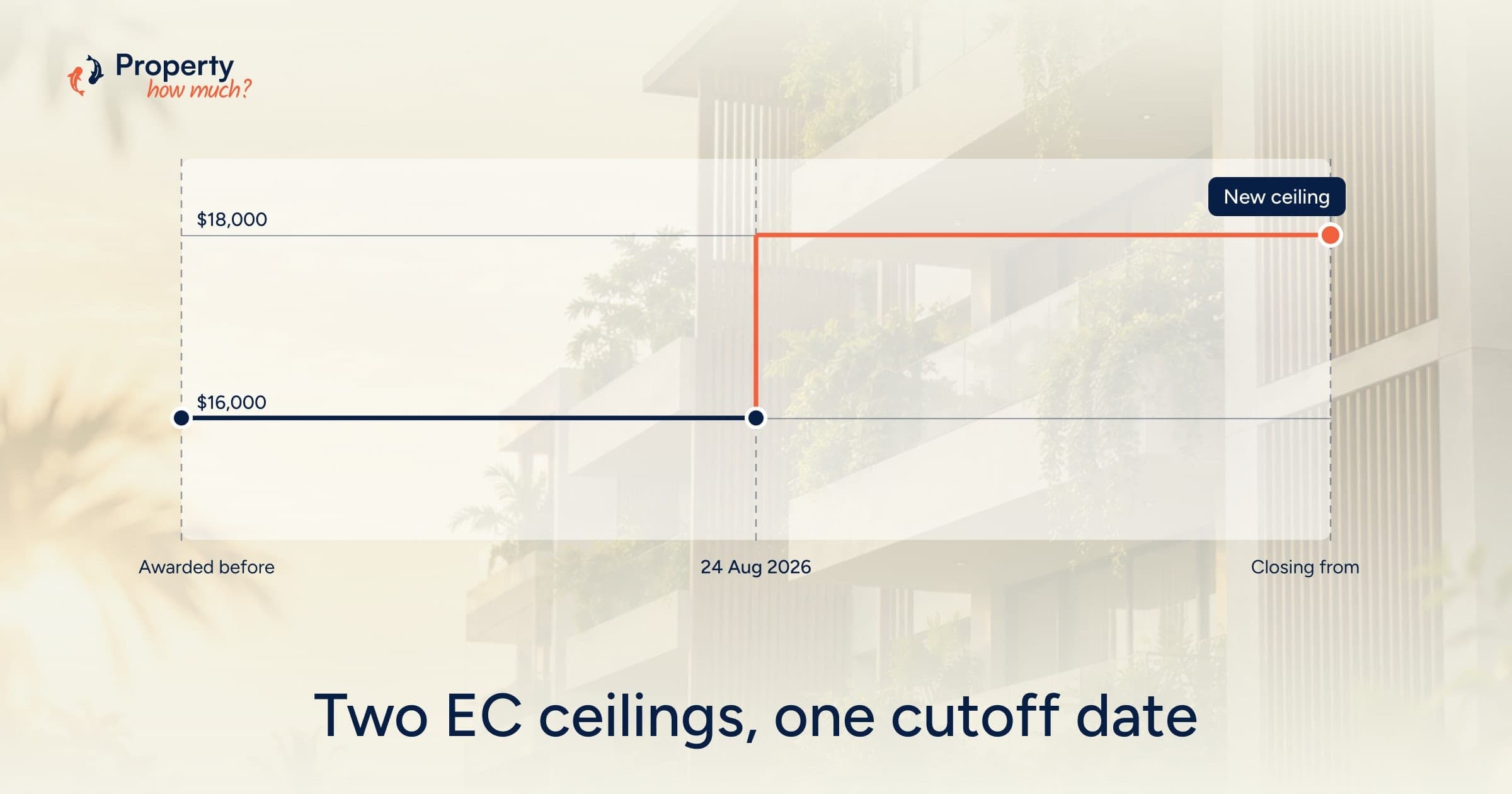
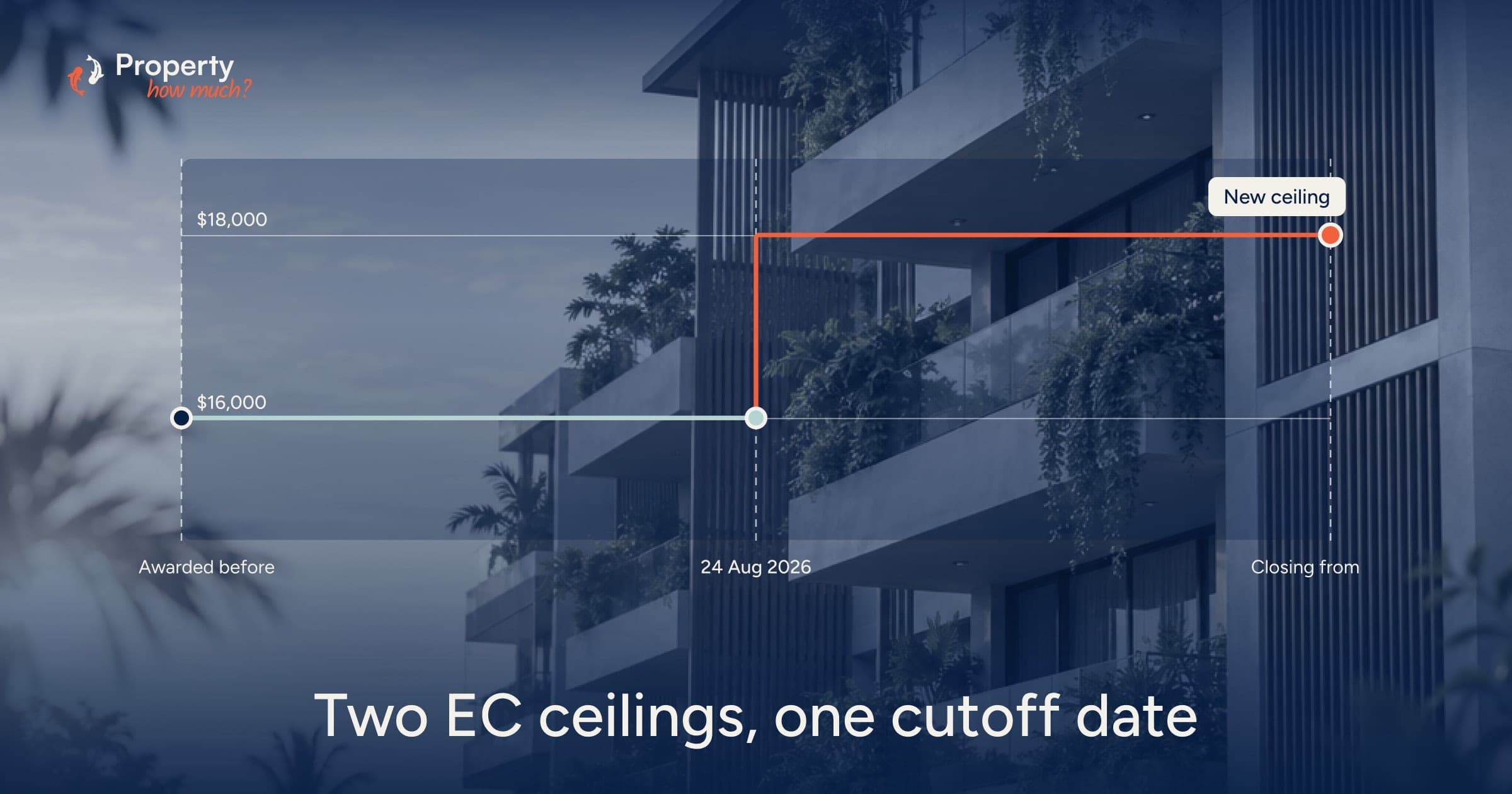
Both figures are possible in 2026, and it comes down to the land tender date. The cutoff date is 24 August 2026. Any EC on a site whose tender closes on or after the cutoff enjoys the $18,000 ceiling, whereas a site awarded before it stays at $16,000. For resale ECs after their minimum occupation period (MOP), there is no income ceiling, no change.
When and why was the ceiling raised?
Prime Minister Lawrence Wong announced the change at the National Day Rally on 23 August 2026. The EC ceiling rose from $16,000 to $18,000, and the BTO ceiling rose from $14,000 to $16,000.
His reason was that Singaporeans are marrying later. "By the time they settle down, many are further along in their careers and earning more," he said. "So more young couples are crossing the current income ceilings."
What's a land tender and how are they awarded?
Every new EC starts as a plot of government land. HDB sells these plots to private developers through public tenders, under the Government Land Sales programme. The Government announces this programme every six months.
A tender has three key dates:
- Launch: the site opens for bids.
- Close: bidding ends. This date decides if the EC gets the $18,000 ceiling.
- Award: the Government picks the winner. It compares the top bid with a reserve price, set at 85% of the Chief Valuer's estimated market value, and it can refuse a bid that is too low.
Since 2021, all 15 EC tenders have gone to the highest bidder. A typical tender stayed open for about three and a half months, and the award came about two weeks after it closed.
The first EC site under the $18,000 ceiling is at Canberra Drive in Sembawang. Its tender launched on 26 May 2026 and closed on 1 October, with 13 bids. It was awarded on 15 October for $163.9 million.
How is the income ceiling calculated?
HDB counts the average gross monthly income of everyone on the EC application, both buyers and occupiers. So a working parent listed as an occupier adds to your household income.
That parent cannot share your loan. Only a buyer of the home can be a borrower, so an occupier's pay counts towards the ceiling but does not raise how much you can borrow.
If you are over the ceiling, you can appeal to HDB. It looks at each case separately and considers hardship such as heavy, ongoing medical bills, The Straits Times reported. HDB approved 845 of the 2,583 appeals filed from 2020 to 2025, or about one in three.
What new ECs cost this year
The typical new EC sold by developers this year, up to 15 November, cost about $1.8 million. A typical 3-bedroom cost about $1.68 million, and a typical 4-bedroom cost about $2.02 million.
How much bank loan can you take out?
Probably less than you expect, so plan for a down payment much bigger than 25%.
A bank can lend up to 75% of the price. But until an EC's MOP ends, your loan instalments cannot exceed 30% of your gross monthly income, and banks must test that at 4% a year or higher. On a 30-year loan, a household earning $16,000 can borrow about $1 million.
You pay the rest with cash and CPF, and at least 5% of the price must be cash. Households earning above $12,000 get no CPF Housing Grant to help. Here is what that means at a $16,000 income:
| Coastal Cabana | Rivelle Tampines | |
|---|---|---|
| TOP | 2029 | 2029 |
| Nearest MRT | Pasir Ris | Tampines West |
| 3-bed | $1.65M ($1,805 psf) | $1.76M ($1,928 psf) |
| 3-bed down payment | $644,000 (39%) | $753,000 (43%) |
| 4-bed | $1.86M ($1,790 psf) | $2.12M ($1,936 psf) |
| 4-bed down payment | $856,000 (46%) | $1.11M (52%) |
| 5-bed | $2.50M ($1,769 psf) | $2.67M ($1,940 psf) |
| 5-bed down payment | $1.49M (60%) | $1.67M (62%) |
Looking at this year's two new launches, Coastal Cabana and Rivelle Tampines, the prices and the loan limit together make the down payment very large. It is a real question whether it is wise to put more than $500,000 into an EC, or to use the same sum with a much larger mortgage on a fully private new launch or resale condo.
A private condo does not have the 30% limit. Its limit is 55% of income, across all your debts, so the same household could borrow about $1.84 million.
Pinery Residences shows the trade-off. It is 230 m from Rivelle Tampines, has a 99-year lease and launched in the same month. A typical 3-bedroom there cost $2.42 million ($2,542 psf), against $1.76 million ($1,928 psf) at Rivelle, so the EC is about 24% cheaper per square foot. But the Pinery unit needs a down payment of about $604,000, against $753,000 at Rivelle, because the bank can lend more.
The price of that choice is a much bigger loan: $1.81 million against $1 million. Banks would test it at about $8,650 a month, against $4,800 for the EC.
These sums assume that every earner is a borrower, has no other debts, and will finish the loan by age 65. No EC at the $18,000 ceiling is on sale yet. At similar prices, those buyers could borrow about $126,000 more.
What can your household buy?
New EC up to $1.46M. Private condo up to $1.76M.
Have new EC sales picked up since the announcement?
No. Developers sold 18 new EC units in August, 25 in September and 15 in October. The two tall bars this year are the launches of Coastal Cabana in January and Rivelle Tampines in March.
Nothing has come through at the new ceiling yet. Every new EC sold since 24 August is on an older site, so it still uses $16,000. Canberra Drive, the first $18,000 site, was awarded only in October and has not started selling.
Have EC prices moved since the announcement?
Not so far. In the 12 weeks after the announcement, new ECs sold at a median of $1,848 per square foot, against $1,846 in the 12 weeks before. Resale ECs sold at $1,467, against $1,466.
- New ECs
- Resale ECs
Did EC sales speed up after the announcement?
New launches: we cannot tell yet, because no EC has launched since the announcement. Both launches this year came before it. Coastal Cabana sold 416 of its 748 units in its first week, and Rivelle Tampines sold 445 of its 572.
ECs already on sale: they did not speed up. Developers sold 49 units in the 12 weeks after the announcement, against 68 in the 12 weeks before. Coastal Cabana sold 40, against 45. Rivelle Tampines sold 7, against 21, but it has few units left.
Resale ECs: sales held steady, with 373 in the 12 weeks after the announcement, against 385 in the 12 weeks before.
That is what you would expect. The higher ceiling does not apply to any EC on sale yet, and resale ECs have no income ceiling.
What to do before you book an EC
- Find out when the project's land tender closed or was awarded, and compare it with 24 August 2026.
- Add up the gross monthly income of everyone you will list, occupiers included.
- Ask the developer which income documents it needs, and how it counts bonuses or a recent pay rise.
- Ask a bank for a loan figure based on your own incomes, ages and debts.
- If you are just above the ceiling and face heavy costs such as medical care, ask HDB about an appeal.
- If your household earns more than the higher ceiling, look at resale ECs that have met their MOP.